Hybrid + BESS — BK-PLTS-B
Fuel saver
PLTS Paket B — Solar Resilience
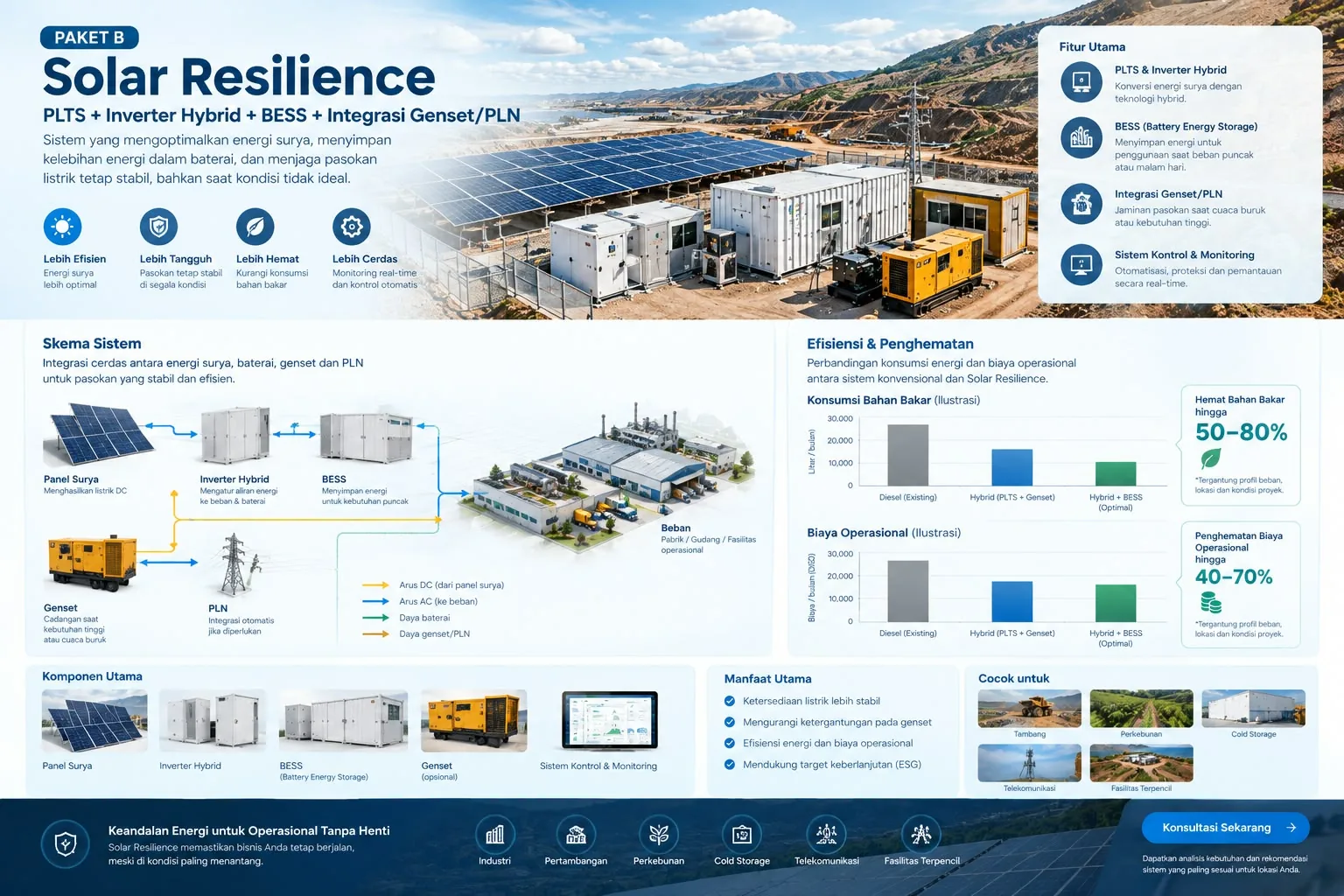
Solar, battery storage, and hybrid control that keep the site running when the grid or genset drops.
A hybrid PV system with battery energy storage for sites that cannot afford an outage. Solar carries the daytime load, the battery covers peaks and short outages, and the genset or PLN connects seamlessly as backup.
50–80%
Fuel savings
40–70%
Lower operating cost
100%
Critical-load reliability
24/7
Remote monitoring
The package
What Paket B
is built for.
Paket B is built for operations where energy reliability matters as much as cost. A hybrid inverter coordinates three sources — solar, battery, and the existing genset or PLN connection — so the site draws from the cheapest source available at any moment.
The battery absorbs midday solar surplus and discharges it into the evening peak or the next outage. Generator run-hours fall because the genset no longer idles through low-load periods; typical fuel savings are 50–80%.
Sizing is driven by the critical load profile, not the total connected load. We separate must-run equipment from deferrable loads, then size the PV array, BESS, and inverter around the critical block so the system stays economical.
Best for
- Industrial plant
- Mining
- Plantation
- Cold storage
- Telecommunications
- Remote facility
At a glance
- — Hybrid inverter with seamless source transfer
- — LFP battery storage sized to the critical load
- — Genset/PLN synchronisation and load management
- — Energy management system included
What is included
Everything in the
Paket B package.
- — Tier-1 monocrystalline PV modules
- — Hybrid inverter with multi-source transfer
- — LFP battery energy storage system
- — Genset and PLN synchronisation
- — Energy management system and load control
- — Remote monitoring, alarms, and reporting
Final capacity, Bill of Materials, and price are confirmed after the free technical feasibility study. No payment is taken on this page.
Scale check
What 1 kW to 1 MW looks like.
This is the same sizing instrument used across the PLTS family, pre-set to the load profile that suits Paket B.
Sizing instrument
From 1 kW to 1 MW.
Pick a load profile, then move along the rail. Each setting shows the PV array, usable battery, module count, inverter count, and mounting area you would expect for that scale.
Indicative pre-feasibility
Commercial sites with evening load
100 kWp
Indicative design
100 kWp
Mixed profile · 12 h/day
- Usable BESS
- 200 kWh
- Load served
- 28 kW
- Daily generation
- 336 kWh
- Load served
- 28 kW
- Usable BESS
- 200 kWh
- 650 Wp modules
- 154 units
- Inverters
- 2 × 50 kW
- Mounting area
- 400 m²
- Annual yield
- 123 MWh
- CO₂ avoided
- 107 t/yr
Indicative only: 4.2 peak-sun hours per day, 80% performance ratio, 650 Wp modules at 2.6 m² each including access, tiered string inverters, and a 0.87 t CO₂/MWh grid factor. A measured load study sets the final design.
100 kilowatt peak, Mixed profile, 200 kilowatt-hour battery, 154 modules, 2 inverters.
The common standard
Every package is engineered, not assembled.
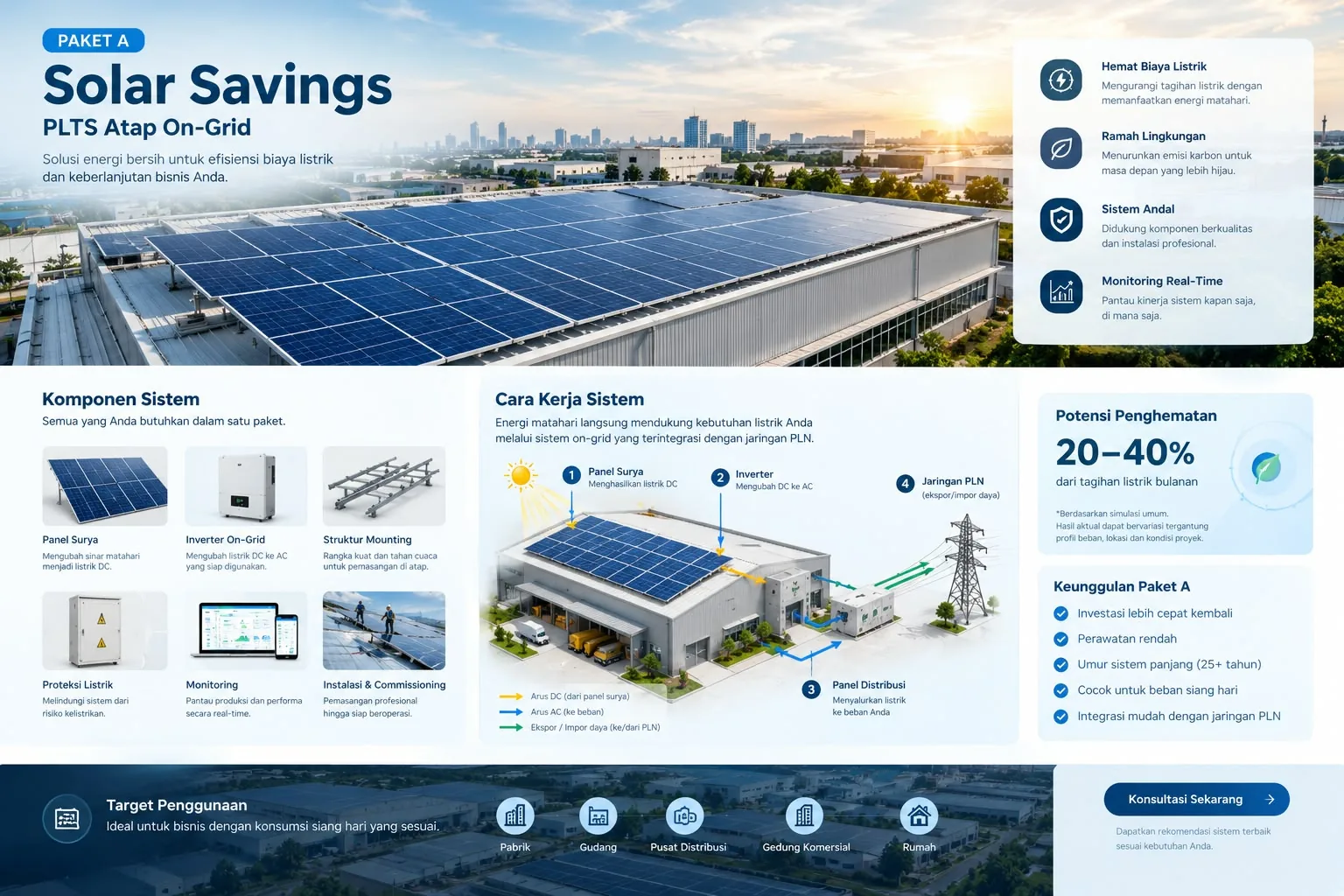
Each Bamantara PLTS package starts with a load study and a single-line electrical design. Tier-1 monocrystalline modules, IEC/SNI protection, structural mounting, commissioning, and remote monitoring are included as standard. The final scope and price are confirmed after a free site survey — no estimate on this page replaces a stamped design.
- — Load study and single-line electrical design before pricing
- — Tier-1 monocrystalline modules with a 25-year performance warranty
- — IEC/SNI protection, earthing, and surge devices
- — Structural mounting designed for local wind and roof loads
- — Commissioning, as-built documentation, and remote monitoring
- — Free site survey and technical feasibility study across Indonesia
FAQ
Questions about Paket B.
How long can the battery carry the site?
Can Paket B integrate with an existing genset?
Does the battery require a cooled room?
What is the payback on a hybrid system?
The PLTS family
Other packages
Send the load.
We will size the plant.
Share your site, load profile, and operating hours. Our engineers will return a technical feasibility study and a Paket B recommendation.